Relying on Google Gemini to plan their trip proved costly for three hikers in California, as they ended up facing a harrowing ordeal. They trusted the AI so implicitly that they were forced to spend the night in a dense forest without food or water. Here are the details of the entire incident…
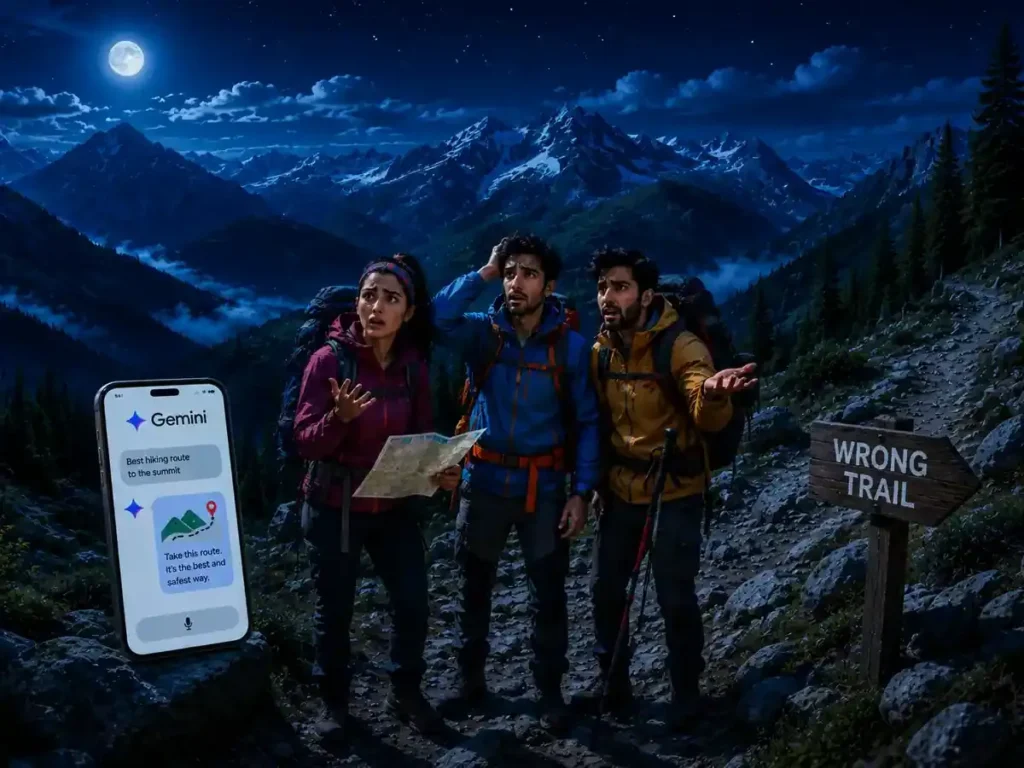
Relying on Google Gemini backfired for three mountaineers, causing them to lose their way in the mountains. If you also turn to AI for advice on various tasks, take heed. Nowadays, we all use AI for one thing or another—whether it’s writing, coding, creating presentations, or even deciding what to eat or drink. However, there is one crucial thing to remember before using any AI chatbot: while you can certainly seek help from tools like Claude, ChatGPT, and Gemini, you should never trust them blindly. The experience of these three mountaineers proves this point. Three hikers in California learned this lesson the hard way; they placed so much trust in Gemini AI that they ended up stranded in a dense forest. Here are the details of the incident…
Sought advice from Gemini before the climb
Three individuals from Roseville, California, set out from the Clear Creek Trailhead on August 29, hoping to complete the climb up Mount Shasta in about eight hours. They had used YouTube, AllTrails, and Gemini AI to gather information about the route, plan their ascent, and decide what gear to pack.
According to an official post by the Siskiyou County Sheriff’s Office, the climbers set up camp at an elevation of approximately 8,400 feet and began their ascent toward the summit at 3:00 AM the following morning. However, the climb took much longer than they had anticipated.
Situation worsened during the descent
By the time they reached the summit, it was nearly 7:00 PM—hours past their planned return time. This meant they had to descend in the dark. That is precisely when things started to go wrong. About an hour into their descent, the climbers called the Siskiyou County Sheriff’s Office dispatch for directions. However, shortly after the call, they strayed off their path and headed toward Mud Creek Canyon.
Climbers Stranded on the Mountain, Hungry and Thirsty
Later that night, one climber fell and injured his knee. The group eventually stopped at an elevation of approximately 11,000 feet and spent the night stranded on a steep slope. By then, all three men were exhausted, hungry, and thirsty, as Gemini had advised them to carry minimal food and water so they could travel with lighter packs.
US Forest Service climbing rangers reached them around 9:30 the next morning. The rangers treated the injured climber and provided food and water to the group before assisting them in their descent.
However, the rescue operation was not straightforward. According to officials, two attempts to rescue them by helicopter failed due to strong winds, forcing the climbers and rangers to descend on foot. They finally reached base camp around 3:00 PM, where the Siskiyou County Search and Rescue team helped transport them to the Clear Creek Trailhead. The rescue operation concluded around 6:30 PM.
After the rescue, the climbers revealed that they had relied heavily on Google’s Gemini AI for route information and advice on what to pack. The Sheriff’s Office described this as a “serious mistake” and warned climbers never to rely on AI to plan their trips.